Science Unshackled by C. Renée James
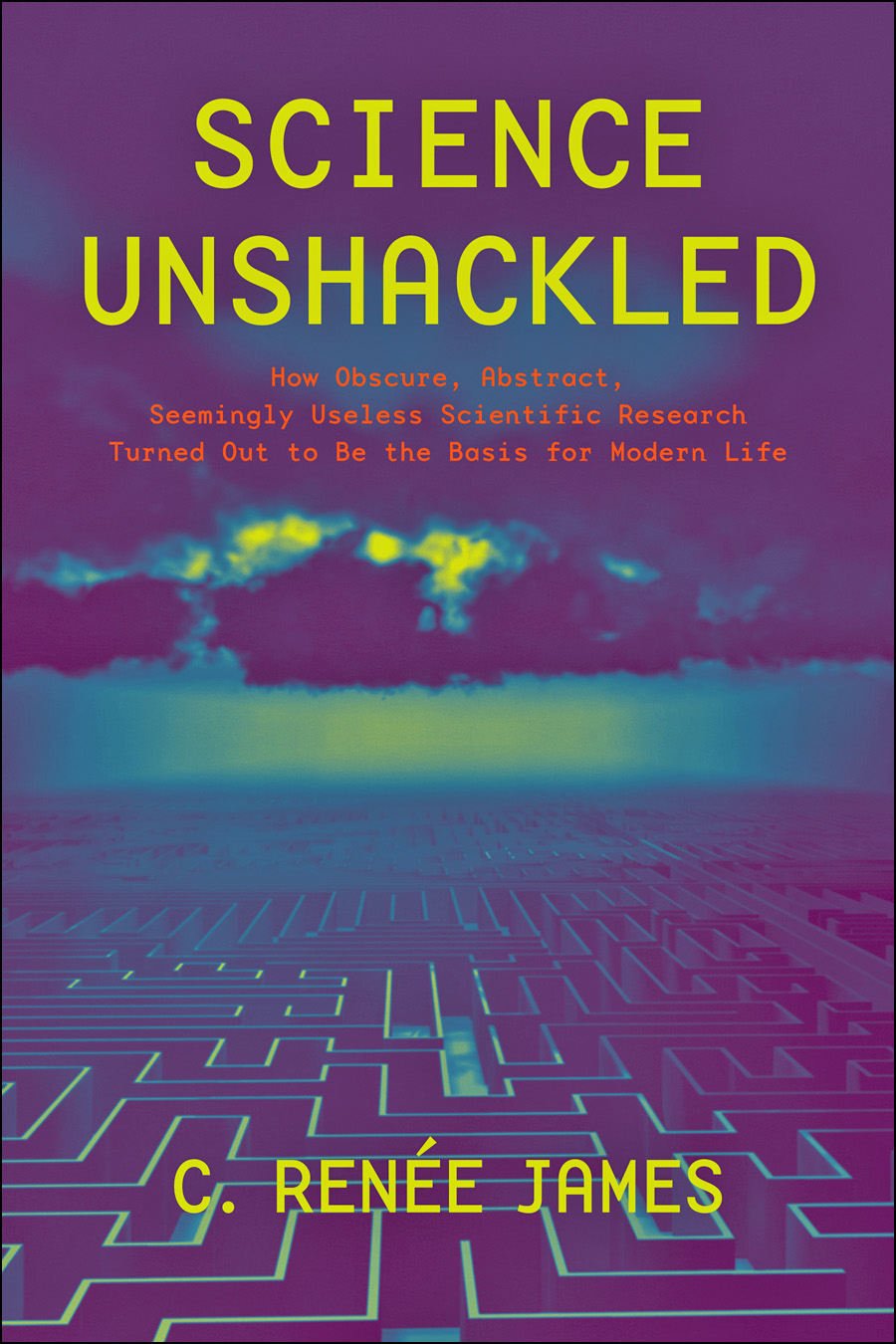
Author:C. Renée James
Language: eng
Format: epub
Publisher: Johns Hopkins University Press
Published: 2014-10-07T16:00:00+00:00
18 CLASSIC BLACK
Go outside and take a good look at the night sky. The first thing that leaps out to the casual observer is that the darkness is punctuated by small dots—stars—where matter is concentrated. These concentrations have gaping chasms of near nothingness (at least, as far as our eyes can detect) between them. In fact, if the Earth-Sun distance were scaled down to a couple of centimeters (an inch) and both the Sun and Earth were reduced to specks, the next nearest speck (Proxima Centauri) would be 6.4 kilometers (four miles) away. With the aid of a telescope we can see island universes called galaxies, again with vast distances separating these relatively puny and dense clumps of matter. Galaxies cluster together on even grander scales, concentrated filaments and blobs of mass among unimaginably great voids of space.
These are fairly basic observations of the current universe. What is harder to see is what these grand concentrations of matter are doing. Edwin Hubble found in the 1920s that, by all appearances, galaxies are rushing away from each other and from our own Milky Way galaxy. This is not a motion that we can watch unfold, as the scales are so great that none of it has changed noticeably over the entire history of humankind. Instead, we take advantage of a simple way to gauge the speed of the objects in the universe, something we’ve been doing since the 1840s, when Christian Doppler realized that the changing pitch of trumpet players on a moving train told us about something more than music.
Just as the note from a horn played on a passing train seems to shift from a higher pitch (corresponding to shorter sound waves) to a lower pitch (corresponding to longer sound waves) when the train passes, light from moving objects in the universe will display shifts that depend on their motion relative to us. Doppler knew this should be the case, but in the 1840s, technology was not up to the task of discerning this wavelength shift in light.
Fast forward to Hubble, who was lucky enough to live in a time when the subtle shifts to longer or shorter wavelengths of light could be detected and measured. When looking at 46 galaxies, he found that the light from all but one of them showed a wavelength shift to longer, redder waves. In other words, the galaxies’ spectra were redshifted. And just as the lower pitch of an ambulance siren means it’s moving away from you, the redder wavelengths of the galaxies seemed to indicate that they are moving away from the Milky Way.
As if that weren’t weird enough, Hubble also discovered that the more distant a galaxy was, the larger its redshift was, which only made the situation more bizarre. Why should the Milky Way appear to have such a central location? And how do those distant galaxies know how far they are away from us so that they know to adjust their speeds accordingly?
Over the next few decades, cosmologists
Download
This site does not store any files on its server. We only index and link to content provided by other sites. Please contact the content providers to delete copyright contents if any and email us, we'll remove relevant links or contents immediately.
Whiskies Galore by Ian Buxton(41950)
Introduction to Aircraft Design (Cambridge Aerospace Series) by John P. Fielding(33098)
Rewire Your Anxious Brain by Catherine M. Pittman(18603)
Craft Beer for the Homebrewer by Michael Agnew(18207)
Cat's cradle by Kurt Vonnegut(15277)
Sapiens: A Brief History of Humankind by Yuval Noah Harari(14335)
Leonardo da Vinci by Walter Isaacson(13254)
The Tidewater Tales by John Barth(12635)
Thinking, Fast and Slow by Kahneman Daniel(12179)
Underground: A Human History of the Worlds Beneath Our Feet by Will Hunt(12062)
The Radium Girls by Kate Moore(11988)
The Art of Thinking Clearly by Rolf Dobelli(10354)
Mindhunter: Inside the FBI's Elite Serial Crime Unit by John E. Douglas & Mark Olshaker(9274)
A Journey Through Charms and Defence Against the Dark Arts (Harry Potter: A Journey Throughâ¦) by Pottermore Publishing(9252)
Tools of Titans by Timothy Ferriss(8327)
Wonder by R. J. Palacio(8074)
Turbulence by E. J. Noyes(7994)
Change Your Questions, Change Your Life by Marilee Adams(7700)
Nudge - Improving Decisions about Health, Wealth, and Happiness by Thaler Sunstein(7670)
